Exploratory QA
A vision model uses tonight's build the way a person would, and leaves a short list of reproduced bugs for the morning.
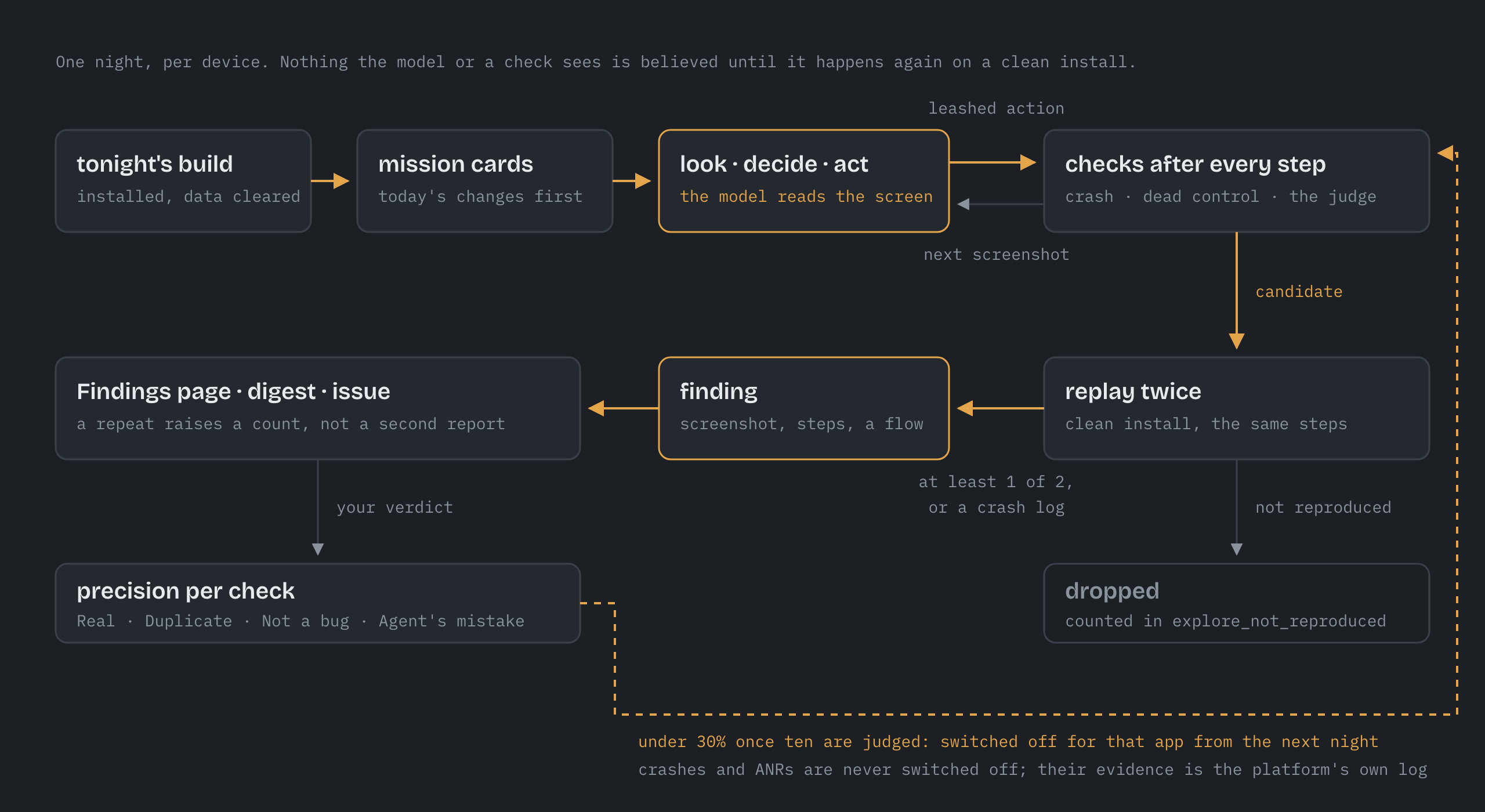
Scripted UI tests check what somebody thought to write down. explore looks
for what nobody did: a crash two screens past the happy path, a button that
does nothing, a form that throws on a decimal, a label that overlaps its value
in Spanish. A model reads each screenshot and picks the next action; the
harness checks that action, performs it, and looks for trouble after every
step. Nothing it sees is believed until it happens again on a clean install.
What you get in the morning
Each finding on the dashboard's Findings page has:
- the screenshot at the moment it happened;
- the steps that led there, in words ("On Add plant: type "a few" into Name, tap Save");
- the evidence: the crash log, the judge's description, or the control that did nothing;
- how it replayed ("reproduced 2/2", "flaky 1/2", or "crash log" when the crash itself is the evidence);
- a contact sheet of the walk that led there, the full trajectory, and a Maestro flow (or a tvloop flow, on a Roku) that replays it;
- four buttons: Real, Duplicate, Not a bug, Agent's mistake.
The same finding seen again on a later night raises a count rather than making a second report. Your verdicts decide which checks keep running.
What it can drive
| Surface | How | State |
|---|---|---|
| Android phones and tablets | adb, by touch | Verified on an emulator with a real model |
| Fire TV and Android TV | adb, by D-pad | Verified on an emulator with a real model |
| iOS and tvOS simulators | the FleetDriver UI-test bundle | Verified on 26.5 simulators, without a model |
| iPhones and Apple TVs | FleetDriver over the CoreDevice tunnel | Written, never run |
| Roku | tvloop | Verified on tvloop's fake Roku; a real Roku needs its developer password |
Where to go next
-
A small open model, an emulator, the bug garden, and a scored night in about half an hour.
-
The loop, the checks, the replay, and why nothing is filed on one sighting.
-
What the explorer is told to do, per app, and how to write a good one.
-
Every parameter, environment variable, metric and artifact.
-
What a model needs, the tool dialect it is spoken to in, and how to pick one.
-
The three actuators, the FleetDriver protocol, and adding a fourth.
-
What the harness refuses, and why the model's intent is never trusted.
-
The API, the page, precision, the digest, and GitHub issues (off by default).
-
The pointing test, step time, the mission bench, the bug garden and the bake-off.
-
Blank screenshots, a cold cache, false findings, and the rest of what real devices taught it.
-
The code map, the contract between the parts, and how to add a check or an actuator.
-
The production setup on the Mac Studio, phase by phase, with the numbers each phase must reach.
Honest status
Built and tested on 2 October 2026 on a laptop, with Qwen3.5-2B standing in for the real model. Those runs say the harness works and nothing about how good the intended model is.
On 8 October the intended driver, Holo4 35B-A3B (Apache 2.0), was
measured on ultra:
100 of 100 pointing targets, a median whole step of 6.8 s, and a tool call on
all 40 steps of a mission once tool_choice was required. Its first
bug-garden mission filed BG-01 and BG-03, and a night through the brain filed
BG-16, each reproduced 2/2. That is one model on one fixture app. No
model-driven night has run on an Apple surface yet, and the phase exits in the
ultra runbook are still the bar.