Every screen is a device
What can join this fleet, what it takes, and — for each one — whether that has actually been done or is only believed to work. The last column is the point of the page. A list of platforms a project "supports" is worth very little; a list that says which ones somebody has watched register is worth something.
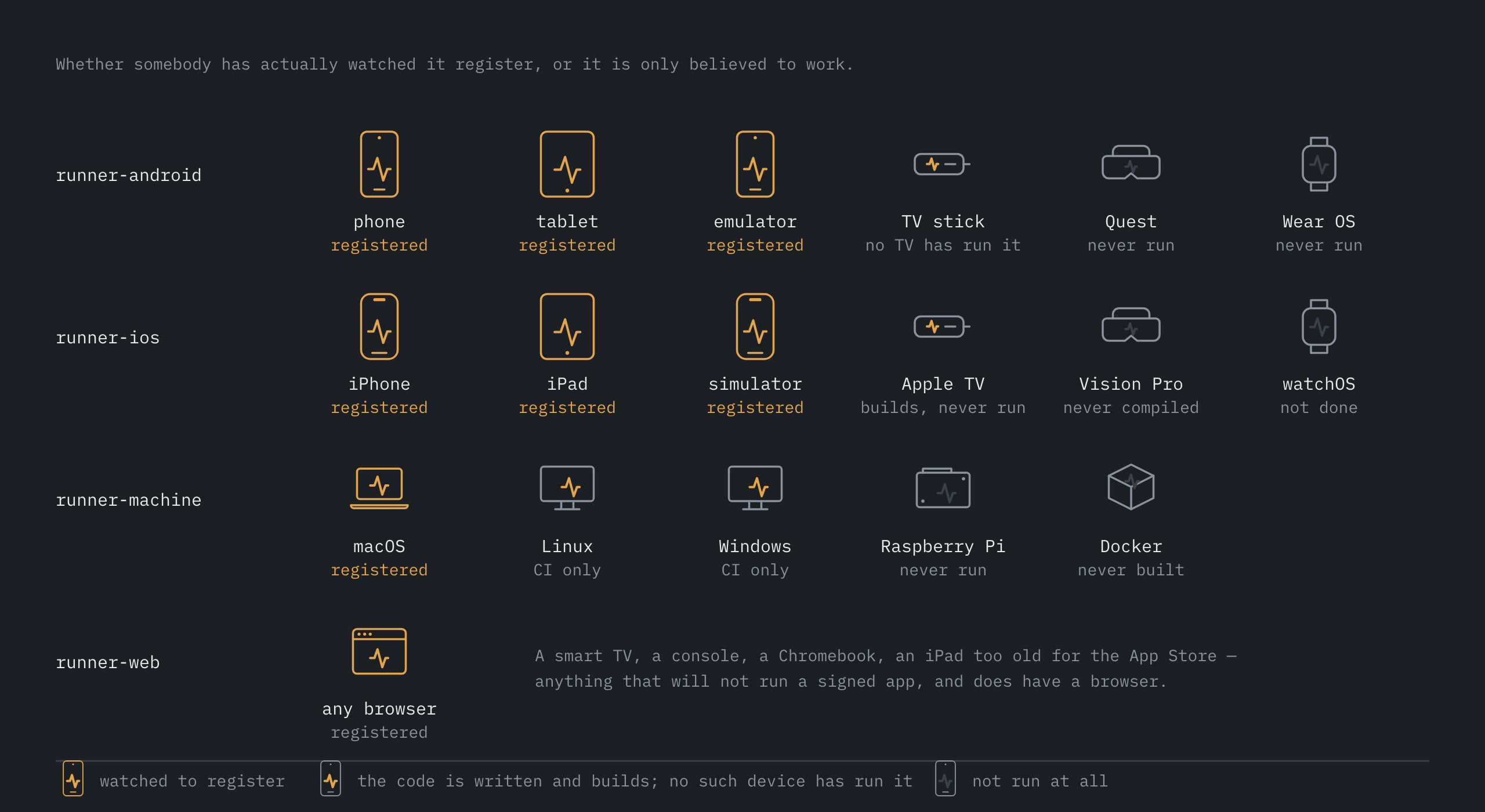
The shelf today
| Platform | Runner | How it joins | Verified |
|---|---|---|---|
| Android phone, tablet | runner-android |
adb install, or sideload |
yes — the original shelf |
| iPhone, iPad | runner-ios |
Xcode, TestFlight internal | yes |
| iOS simulator | runner-ios |
simctl install |
yes |
| macOS, Linux, Windows | runner-machine |
fleet up, or npm start, or a LaunchAgent / systemd unit |
macOS yes, on both architectures — an Apple M1 Pro and a 2016 Intel i7 both registered, passed npm run conformance, and produce comparable synthetic numbers with matching digests; both run under fleet service. Linux and Windows run their suite in CI on x64 and arm64, and neither has registered against a real collector — see what each one reports |
| Android emulator | runner-android |
adb install to the emulator |
yes |
What Wave 5 added
| Platform | Runner | How it joins | Verified |
|---|---|---|---|
| Any browser | collector/runner-web/ |
open http://<collector>/runner |
yes — driven end to end by a real Chromium against a real collector, both backends, digest checked |
| Android TV, Google TV, Fire TV | runner-android |
adb connect, then adb install |
partly — the built APK declares a leanback launcher and a banner, checked with aapt2 dump badging. No TV has run it |
| Meta Quest | runner-android |
sideload via adb |
no — Quest is Android 12 and reports UI_MODE_TYPE_NORMAL, so the runner identifies it by the VR feature flag. Never run on one |
| Wear OS | runner-android |
adb install over Wi-Fi debugging |
no — the watch feature flag is read and declared; never run on one |
| Apple TV (tvOS) | runner-ios, FleetRunnerTV target |
devicectl or simctl |
builds — xcodebuild -scheme FleetRunnerTV succeeds. No Apple TV has run it |
| Vision Pro (visionOS) | runner-ios, FleetRunnerVision target |
devicectl or simctl |
no — the target is written and has never been compiled; the visionOS platform is not installed on the machine it was written on |
| Raspberry Pi, Jetson, Steam Deck | runner-machine |
install-agent.sh, or the Docker image |
no — but arm64 Linux in CI reports a nearly complete descriptor, so a board should register cleanly. No board has |
| Anything with Docker | fleet/Dockerfile |
docker run ghcr.io/addisdev/fleet |
builds — CI built and published the image for linux/amd64 and linux/arm64 at v0.5.0. No container has been run: Docker was not available on the machine that wrote it, so the image assembling is all that is known |
What Wave 6 added
| Platform | Runner | How it joins | Verified |
|---|---|---|---|
| Roku player, Roku TV | runner-roku |
build.sh --install <ip>, then an ECP launch |
no -- and less verified than anything above it. No Roku was available and no Roku emulator exists, so the channel has never been compiled, let alone run: BrightScript's only compiler is inside a television. See Roku: the one that could not be compiled |
| Roku, from the executor | collector/src/drivers/roku.ts |
SSDP discovery on the LAN | partly -- the SSDP and device-info parsers are checked against recorded response shapes in drivers.test.ts; the UDP socket path is exercised by nothing, and no Roku has answered it |
Android: one APK, every shape
The Android agent is a foreground service and a text field. Nothing in it needs a phone, and it was never a code problem — it was a packaging one. Three declarations in the manifest do the work:
uses-feature android.hardware.touchscreen required="false"(andfaketouch). A television has no touchscreen, and installers and TV launchers treat that feature as required-by-default and filter the app out entirely.category android.intent.category.LEANBACK_LAUNCHERon the main activity. Without it the APK installs onto a Fire TV perfectly well and then cannot be started from the remote — which reads as "it does not work on TV" and is really "there is no icon".android:banner. A TV launcher draws a 320×180 banner, not an icon.
The phones are unaffected: declaring a feature not-required never removes it from a device that has one.
What differs per shape is only the kind the runner declares, read from
UiModeManager and the VR and watch feature flags. A headset is asked about
before a TV, because Quest reports UI_MODE_TYPE_NORMAL and only the VR flag
tells the truth. Phone versus tablet has no system answer at all, so it uses
the 600 dp rule the resource system itself uses for sw600dp.
Apple: one source, several products
platform is resolved at compile time, not from UIDevice, because it names
the SDK the binary was built against and that is a fact about the binary. A
tvOS build and an iOS build are different products from one source, and a
benchmark table has to be able to tell them apart.
tvOS needed exactly two accommodations, both in the sources rather than in a fork of them:
- No battery API. Not a battery reading
-1—isBatteryMonitoringEnableddoes not exist, because an Apple TV is mains-powered. The runner reports 100% and charging, which is what a permanently plugged-in device is. - No WebKit. The
web-shots:webkitroute is compiled out under#if canImport(WebKit), so an Apple TV never declares the capability — and since the capability list is derived from the route list, the declaration and the code stay one act. A television advertising a screenshot workload it cannot run would take those jobs off the queue from the phones that can.
WebShotsManifest.swift stays in the tvOS target. Its header says it is kept
free of UIKit and WebKit so its parsing can be checked without a device, and
Protocol.swift refers to the type it defines — excluding it took the whole
protocol down with it.
watchOS is not done. The agent, the protocol and the Core ML backend would
compile, but watchOS has no UIKit, so UIDevice and UIApplication need
guards throughout rather than the two tvOS needed — and the watchOS platform is
not installed here, so none of it could be compiled anyway. It is the next
Apple target, not a missing one.
The browser: the one with no install
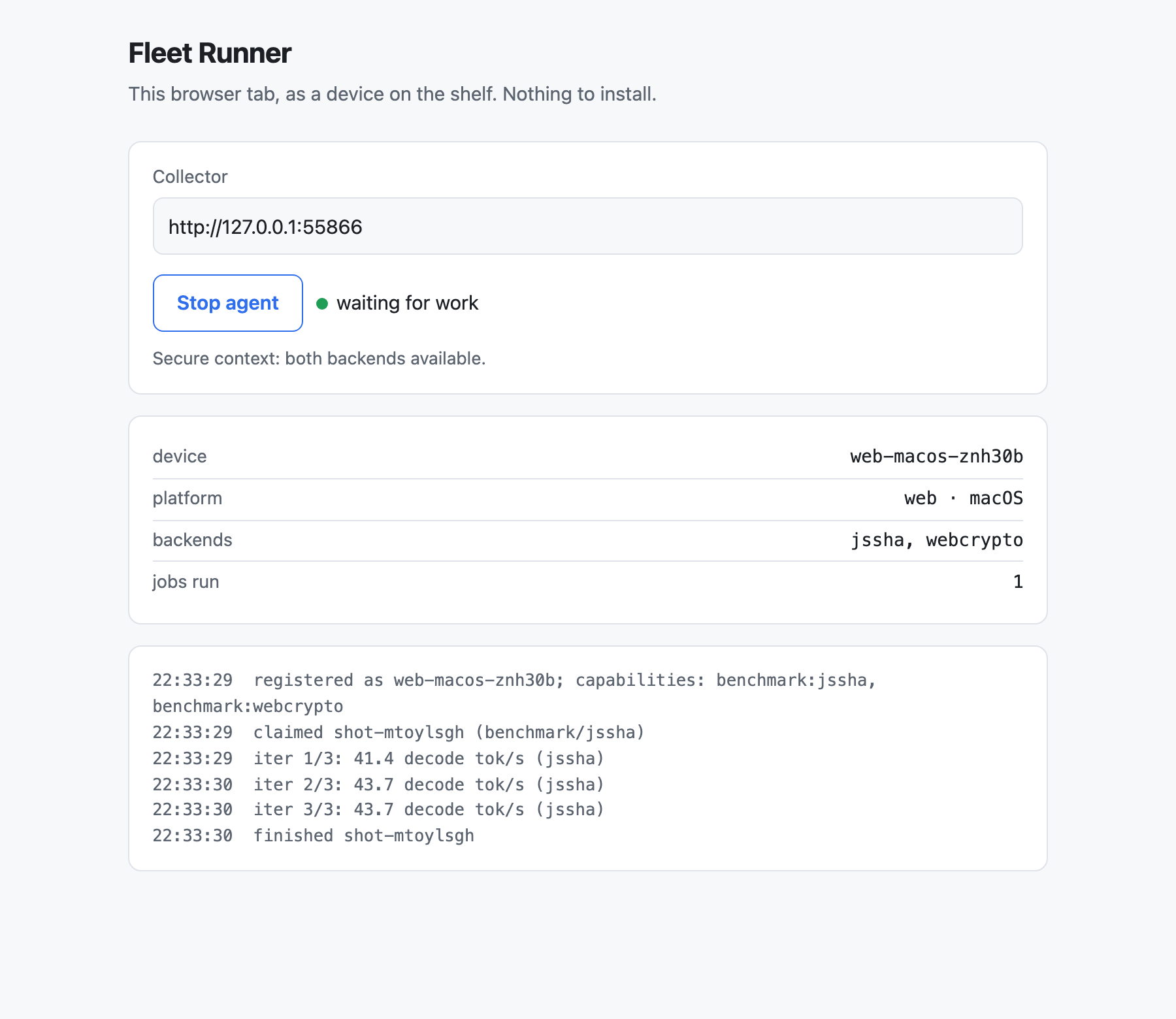
http://<collector>/runner enrols the browser that opens it. A smart TV's
built-in browser, a games console, a Chromebook, a Kindle, an iPad too old for
the App Store, a friend's phone via a QR code — none of them will run a signed
native agent, and all of them have a browser.
Read the backend name before reading a number. The browser runner does not
declare benchmark:synthetic, and that is deliberate rather than an omission.
The fleet's synthetic backend measures SHA-256 throughput; a browser's only
native hash is crypto.subtle.digest, which is asynchronous, so a thousand
sequential folds is a thousand promise dispatches and the scheduler is a large
part of what gets measured. crypto.subtle is also a secure-context API, so on
http://fleet-host.local:8788 — the address a TV browser would use — it is not
there at all.
So there are two backends, each named for what it is:
| Backend | What it measures | Available |
|---|---|---|
jssha |
a synchronous SHA-256 written out in the page; no dispatch overhead, so the rate is the JS engine's throughput and is comparable between browsers | always, including plain HTTP |
webcrypto |
the platform's native SHA-256, paying async dispatch per round | secure contexts only |
Neither is comparable with a native runner's synthetic rate and neither
pretends to be. What is comparable is correctness: both fold the identical
block through identical rounds and both report synthetic_digest, so the
conformance suite proves the browser is doing the fleet's arithmetic even
though its clock means something different.
A hidden tab is throttled by every browser, so the agent stops asking for work when the page is hidden — and aborts an in-flight claim rather than waiting out the collector's 25-second long poll, because a job handed to a tab that went hidden in that window would be measured through the throttle. It registers with a TTL, so a tab that is closed leaves the shelf instead of sitting there forever as an offline device nobody can find.
Roku: the one that could not be compiled
A Roku is the cheapest always-on ARM box in most houses, it is mains-powered,
and it never moves. On paper it is an ideal shelf device.
runner-roku/
is a SceneGraph channel that speaks the protocol: it registers, long-polls,
runs the fold, beacons and reports.
None of it has been run, and none of it has been compiled. Roku has never
shipped an emulator and BrightScript exists only on the device, so there is no
bsc, no linter and no parse step available anywhere off a television. Every
other "no" in the tables above is a runner that at least builds. This one is a
careful hand review and nothing more, and the first syntax error in it will be
discovered by a sideload page. That is worth stating plainly here rather than
only in its README, because this page exists so that a row's last column can be
trusted.
It names its backend roevp, for the browser's reason
BrightScript has no hash of its own. The only one on the platform is
roEVPDigest -- a native OpenSSL object -- called once per round from an
interpreted for loop, and at 4 KiB a round the native hash is a small part of
the work. The rest is the interpreter dispatching a method call, allocating the
returned hex string, parsing it back into a byte array, and copying 32 bytes
with another interpreted loop.
So the rate measures BrightScript's dispatch as much as it measures the SoC,
which is the same shape of problem as crypto.subtle being asynchronous, and it
gets the same answer:
| Backend | What it measures | Comparable with |
|---|---|---|
synthetic |
SHA-256 throughput, natively | every native runner |
jssha |
a browser JS engine's throughput | other browsers |
roevp |
one native hash per interpreted round, so mostly the BrightScript interpreter | other Rokus |
All three fold the identical block through identical rounds and all three report
synthetic_digest, so correctness is shared across every one of them and only
the clock differs. A job asking a Roku for backend: "synthetic" is refused
with a sentence rather than served a roevp number under that name.
Three descriptor fields are null, and that is the interesting part
soc, arch and ram_mb are all null. Roku exposes no CPU model and no core
count; it has shipped both MIPS and ARM devices and no API says which one you
are on; and its only memory API is GetGeneralMemoryLevel(), which answers
"normal", "low" or "critical".
That last one is the refusal worth naming. It would have been easy to map three
words onto a number, and ram_mb is one of the two fields targets.match is
most often written against -- so an invented 1024 would not sit harmlessly in a
descriptor, it would decide which jobs reach the device and then appear in
tables beside numbers that were measured. The pressure signal instead rides on
every beacon as mem_pressure, which is a free-form string in the result schema
and the honest home for it.
Battery reads 100 and charging reads true, the same accommodation tvOS needed
and for the same reason: a Roku is mains-powered, so require_charging is
genuinely satisfied rather than being unmeasurable.
Two things a Roku owner should know before trusting a number
It only runs in the foreground. Roku suspends a channel when the user
presses Home -- there is no background execution model for a channel and no way
to ask for one. A Roku on this fleet is a Roku dedicated to it, or one that
joins between programmes. It registers without a ttl_s for that reason: a
suspended channel is an offline device, not a departed one.
Whether the screensaver suspends it is not known. Roku's documentation does not say whether a channel with no video playing keeps executing behind the screensaver, is suspended, or is left running and throttled. All three are plausible, and the third would quietly produce slow benchmark numbers with nothing anywhere to say why. Nobody has watched a Roku long enough to find out. The test, for whoever has one, is whether the beacons keep arriving after the screensaver appears.
Discovery is the first driver that is not a cable
collector/src/drivers/roku.ts is the first driver in the registry that reaches
devices over the network: an SSDP M-SEARCH for roku:ecp, then
GET http://<ip>:8060/query/device-info. adb, simctl and devicectl all answer
"what is plugged into this Mac?"; this one answers "what Rokus are on this LAN?"
The difference shows up in the shape. SSDP has no end-of-list, so discovery is a fixed listening window rather than a command that returns -- which means a Roku that was asleep or dropped a datagram is simply absent from one pass and present in the next, and there is no way to tell that from there being no more Rokus.
It deliberately does not install. That needs HTTP digest auth, which Node's
fetch does not do, and hand-writing RFC 7616 against no hardware would produce
something that looks finished and fails the first time somebody has a Roku.
runner-roku/build.sh installs with curl --digest instead, reading the
developer password from the executor host's Keychain -- never from a job spec,
which is unauthenticated and rendered on the dashboard.
What a cloud runner actually reports
The machine agent's CI matrix prints the descriptor each platform would send rather than asserting on it, because a cloud runner is allowed to be mostly nulls and pinning a field would fail the day a hosted image changes. What it printed on its first run is worth writing down, because the two Linux and Windows answers are nothing like each other.
arm64 Linux — near enough complete:
{ "model": "Virtual Machine", "soc": null, "ram_mb": 15947,
  "os": "linux-ubuntu-24.04", "platform": "linux", "kind": "ci",
  "arch": "arm64", "cpu_cores": 4 }
Only soc is missing: /proc/cpuinfo on arm64 has no model name line, which
is the field the probe reads. A Raspberry Pi should register cleanly, and would
also fill model from the device tree.
Windows — almost nothing:
{ "model": null, "soc": null, "ram_mb": null, "os": null,
  "platform": "windows", "kind": "ci", "arch": "x64",
  "gpu": null, "vram_mb": null, "cpu_cores": 4 }
Every field there came from wmic, and wmic is a removed feature on
current Windows, not merely deprecated. Only the fields Node answers by
itself survived.
The agent still registered and still ran work — the probes degrade to nulls
exactly as designed, and nothing crashed. But os being null meant a
targets.match expression could never select a Windows machine by its OS, and
ram_mb being null meant it could not be selected by memory either, which left
device_id, platform and arch as the only handles on a Windows agent.
That is the finding the platform matrix was added to produce, and it is the reason it prints the descriptor rather than asserting on it.
What was done about it
The Windows probes now lead with PowerShell Get-CimInstance and keep wmic
as the fallback for older installs, rather than the other way round — one
PowerShell process running six queries, because its startup is the expensive
part and this sits on the path to registration:
| Field | Class |
|---|---|
model, ram_mb |
Win32_ComputerSystem |
soc |
Win32_Processor |
os |
Win32_OperatingSystem |
gpu, vram_mb |
Win32_VideoController |
kind |
Win32_SystemEnclosure, then Win32_Battery |
The same runner now reports:
{ "model": "Virtual Machine", "soc": "AMD EPYC 9V74 80-Core Processor",
  "ram_mb": 16379, "os": "windows-10.0.26100",
  "platform": "windows", "kind": "ci", "arch": "x64",
  "gpu": "Microsoft Hyper-V Video", "vram_mb": null, "cpu_cores": 4 }
os and ram_mb answer, so a Windows machine can be selected by its OS and by
its memory. A hosted runner is a VM, so model reads Virtual Machine — that
is a real answer, not a failure.
Two fields are null on purpose. AdapterRAM is a uint32, so every card with
4 GB or more reports the same saturated ceiling; reporting that as 4095 would
let a match expression asking for 16000 skip the 24 GB machine that could have
run the job, so the field says nothing instead — and the Hyper-V synthetic
adapter above has no dedicated memory to report either way. And kind still
reads ci rather than the chassis answer: a container's hardware belongs to
somebody else, and "this will be gone in four minutes" is the more useful fact.
Adding one
- Write the agent. It registers, long-polls, runs, reports. There is no SDK and no shared library, on purpose — five implementations in five languages keep the protocol honest in a way one library never could.
- Declare
platform,kindandcapabilitiesat registration. Declare only what the agent can actually run: a capability it cannot honour takes a job off the queue from a device that could have run it. - Run the conformance suite:
npm run conformance -- --device <id>. Nine clauses, each of them something that has actually gone wrong here. A skip is fine; a FAIL is a bug in the agent. See Writing a runner. - Add a row to the table at the top of this page, and put the honest answer in the last column.