Fleet Runner
A shelf of old phones, turned into a device lab you can send work to.
One queued job installs a build on every attached device, runs a UI suite across them, benchmarks llama.cpp on real silicon, classifies a few hundred images through Core ML and LiteRT, screenshots a website on two real phone screens and diffs it against a baseline, or drains a battery on purpose and plots the curve. Everything lands in one results database with one dashboard in front of it.
Start here
A collector and a machine agent, supervised, on the machine you are typing on.
Getting fleet is one command -- Install has it per
platform, with an honest column about which of them anybody has actually run a
fleet on. The answer is macOS; the suites run on all three.
-
fleetonto macOS, Windows, Linux or Docker, and how a phone, a television, a Roku or a browser joins. -
fleet up, a real job, and a result you can look at. Node 22.13 and nothing else. -
How the queue thinks: device and host jobs, leases, capabilities, constraints, chains, fan-out and preemption.
-
All 28 of them, what each measures, and what each refuses to guess.
-
Register, long-poll, claim, beacon, report. Enough to write a runner in a language none of ours are in.
-
Publish builds on merge, run a nightly on your own devices, block a pull request on the verdict.
-
Where the services live, keeping them up with
fleet service, and the networking that bites.
How it fits together
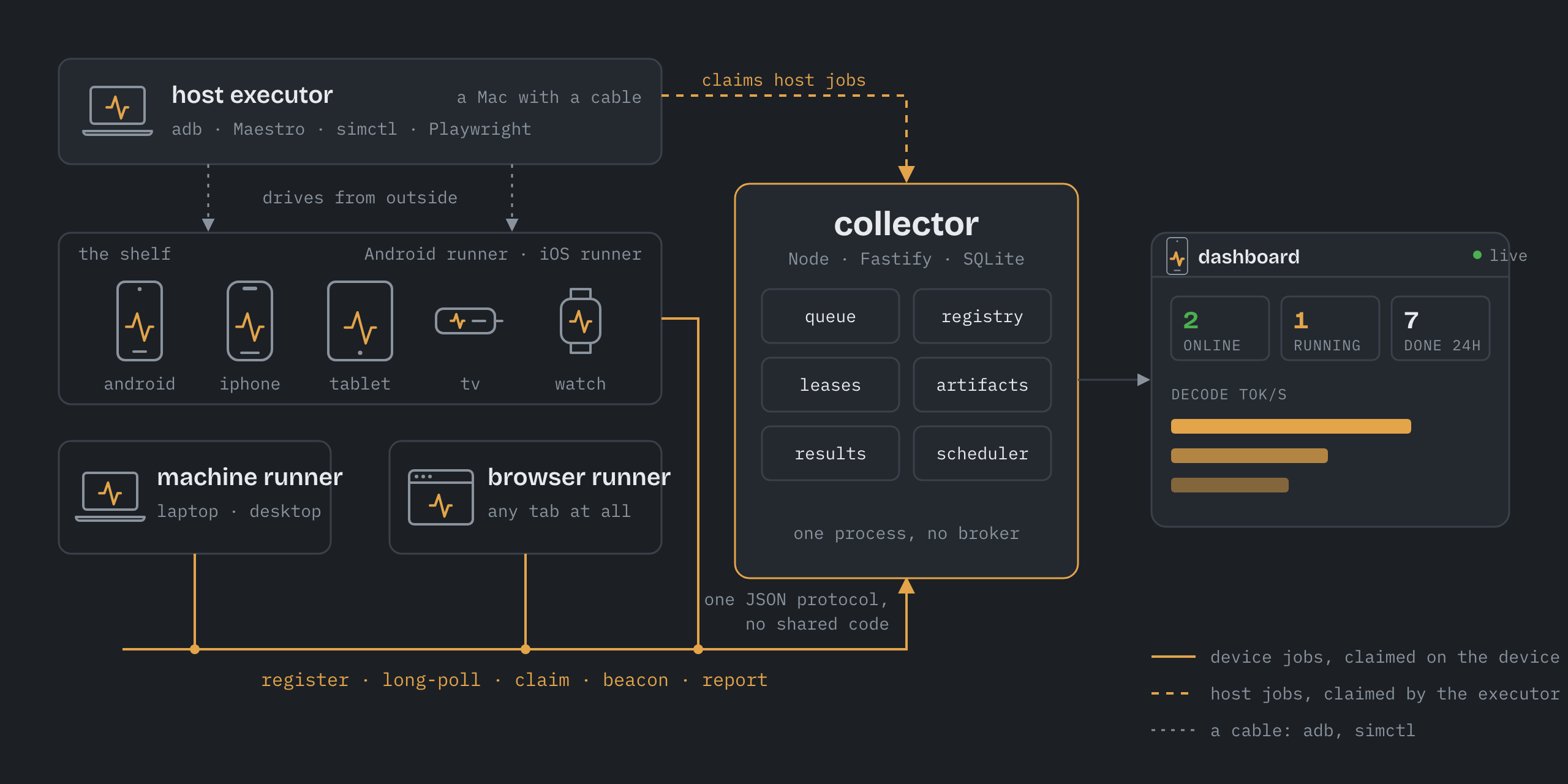
Device jobs are claimed by the agent on the device itself. Host jobs are claimed by an executor on a Mac and drive a device from outside, because installing an APK or tapping through a UI test is not something an app can do to itself.
The runners share a protocol, not code — including a synthetic SHA-256 benchmark that is identical on every platform token for token. That is what lets a 2019 Android phone, a current iPhone and a laptop produce numbers you can put in the same table, which is the difference between a fleet and a pile of phones.
A warning worth reading before you deploy anything
There is no authentication, by design. The collector is meant for a home LAN or a tailnet, and anyone who can reach it can enqueue a job. This is stated as a posture rather than apologised for, and the security policy describes what that does and does not cover. Do not put it on the internet.
Where things live
The code is one repository with seven components that ship independently and share no code, only the protocol.
One brain --
collector/,
which also holds the host executor and the browser runner it serves at
/runner.
Five runners, in five languages, sharing not one line:
runner-android/
(Kotlin),
runner-ios/
(Swift),
runner-machine/
(TypeScript),
collector/runner-web/
(JavaScript) and
runner-roku/
(BrightScript, and never compiled -- see platforms).
And two front doors:
fleet/, the CLI
behind fleet up, and
desktop/, a
menu-bar app around it whose Rust has never been compiled.
The history section keeps the original architecture plan and the design journals as they were written. They are not maintained, and they are kept because the reasoning in them is why the thing is shaped as it is.