Concepts
How the queue thinks. Everything here is the collector's behaviour rather than any one runner's, and it is what you need before writing a job spec that does something more interesting than the one in Get started.
Two kinds of job
Device jobs ("executor": "device") are claimed by the agent running on the
device itself — benchmarks, batch inference, vision evals. The device
long-polls, claims, runs, and reports.
Host jobs ("executor": "host") are claimed by an executor process on a Mac
and drive a device from outside, over adb or simctl. Installing an APK or
tapping through a UI test is not something an app can do to itself, so those
workloads have to live somewhere with a cable to the phone.
A host executor is not a device. It claims from GET /executor/next-job and
selects its own targets from whatever is physically attached to it.
Capabilities
A pool is a label a person applied. A capability is a statement an agent makes about its own code and toolchain, sent with every registration:
{
  "device_id": "pixel-4a",
  "descriptor": { "…": "…" },
  "pools": ["ml-capable"],
  "capabilities": ["benchmark", "batch", "batch:litert", "pipeline"]
}
The queue never hands an agent a workload it did not declare. That is
checked before targets.match, on purpose: an expression narrows the set of
eligible agents, it cannot grant one a workload its code does not contain.
Two rules keep an upgrade from breaking a running shelf:
- No
capabilitieskey means "no opinion", not "nothing". An agent that registered before the field existed is offered every workload, exactly as it was. An agent that sends[]is offered none — the two are different on purpose. - A re-registration that omits the key keeps what was declared last. Rolling back to an older runner build must not silently widen it back to everything.
A job naming a backend is satisfied two ways: by an agent declaring the pairing
(batch:litert) or by one declaring the workload outright (batch), which
means it handles every backend it was built with.
Capabilities are readable from a match expression, so a job can target a toolchain rather than hardware:
What this means for POST /jobs
The collector accepts the workload names it and the host executor ship with — the ones that need no agent to vouch for them — plus any workload some registered agent declares. Anything else is a 422 naming the missing capability, at enqueue time, rather than a job that sits queued forever with nothing to explain why.
That is what lets a new runner add a workload the collector has never heard of without a release in the collector. Writing a runner is the other half of it.
Targeting
Pools still exist and devices still report them, but nothing routes on them
in the schedules that matter. Jobs target with targets.match: a statement
about what the job needs, evaluated against each device's own descriptor at
claim time.
The plant-ID eval is the case that proves the difference. It is LiteRT with a
.tflite model, so it is Android-only. Under pool: ml-capable it fanned out
to three iOS simulators that cannot load it at all. As the expression above it
selects the two Android devices that can — the 3000 MB floor being what the
published eval actually demonstrates, on a 3922 MB emulator.
targets.device_id pins one device. targets.executor pins a host job to a
named executor; unset stays permissive, so anything not pinned is claimable by
whichever executor is free.
Belonging to more than one fleet
An agent may register with several collectors. Two people with two collectors
can share a shelf; a laptop can be a device on the fleet at home and on the one
at work; a machine running fleet up --join <url> is a brain in its own right
whose agent also answers to somebody else's.
What that does not mean is worth saying first, because the restraint is the design:
- Collectors do not share a database, forward jobs, replicate results, or elect anything. A job enqueued on brain A is A's job and lands in A's database, whatever device ran it.
- A brain knows another brain only as an address to read. See the peers API.
The whole of multi-homing is on the device side, and it is one rule: a device runs one job at a time, whoever asked. Two benchmarks running at once produce two numbers that are both wrong, which is the failure this exists to prevent rather than a tidiness argument.
Three mechanisms enforce it, and none of them is sufficient alone.
| Where | What it covers | |
|---|---|---|
| The claim gate | in the agent | Instantaneous. A second job is refused the moment it arrives |
busy on the beacon |
agent → every other brain | Stops the other queues offering at all, within a beacon interval |
POST /jobs/:id/release |
agent → the brain that lost | Cleans up the race the first two cannot close |
The race, and why the obvious fix is wrong
An agent long-polls every brain it knows. Brain A answers with a job. In the
microseconds before the agent can stop asking, B may already have answered too
— and B's job is now claimed by a socket nobody is reading.
The obvious fix is to abort the other polls the instant a claim is taken. It
makes things worse, measurably. A poll that has already been answered — the
brain has run its claim transaction, the row says claimed, the response is in
flight — is one whose job is thrown away by an abort, with no runner and no
release. Tested, that is exactly what happened: one job ran and the other sat
claimed forever.
So the losing poll is allowed to finish, and the job it returns is handed back
with release. Waiting out a long poll costs nothing; the loop is not doing
anything else, and it does not start a new poll while a job is running.
What a runner has to implement
If your agent registers with one collector, nothing here applies and none of it is required. If it registers with several:
- Never hold two claims. Check and set your gate with no
awaitin between. - Send
busyto the brains whose job you are not running. - Release a job you cannot take, and treat a 404 from that endpoint as ordinary — it means the collector predates it, and the lease sweep is the old behaviour.
Clause 9 of the conformance suite checks all three.
Leases
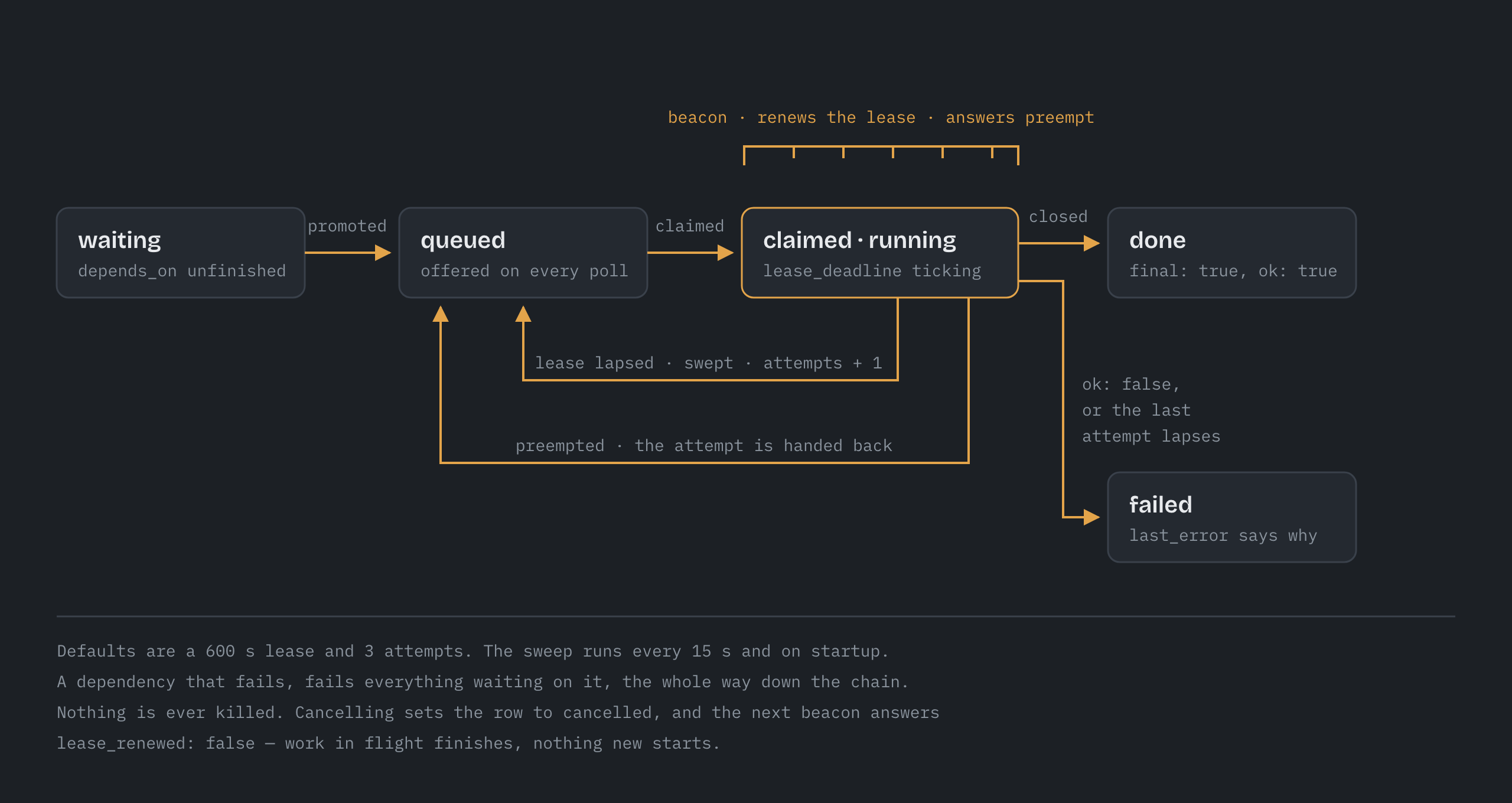
A claim is a lease, not a permanent handoff. Without one, a runner that dies
mid-job — an emulator's low-memory killer taking out the process, a flat
battery, a yanked cable — leaves the job claimed forever and somebody has to
mark it failed by hand in SQLite.
- Claiming a job sets
lease_deadline = now + lease.ttl_sand bumpsattempts. - The runner posts a beacon with the
job_idto push the deadline out. The reply'slease_renewed: falsemeans the claim is gone — swept, or already closed — and the runner should stop working the job. - A sweep runs every 15 s and on startup, and can be forced with
POST /jobs/sweep. Lapsed claims go back toqueued; onceattemptsreacheslease.max_attemptsthe job isfailedinstead. Either waylast_errorrecords what happened.
Defaults are 600 s and 3 attempts. drain and soak default to 14400 s, since
they run for hours between beacons. Pick a TTL longer than the worst-case gap
between beacons for that workload — too short and the collector requeues a job
that is still running perfectly well.
Constraints
constraints is enforced in two places, and which place matters.
The runner enforces require_charging and min_battery_pct, at claim time,
against live state. A device that fails one refuses the job with a failed
result. That is right for a contract about the device: a benchmark on a
throttling phone produces a number that lies, and a lie recorded as a result is
worse than a failure. An on-battery Samsung was observed throttling decode
roughly 100× with the screen off, which is exactly what those constraints exist
to prevent.
The collector enforces require_ac, require_idle_s, max_load and
window, before the claim, against the device's last beacon. An unsatisfied
one leaves the job queued and offers it again on the next poll. A laptop that is
on battery, or busy, or awake at the wrong hour has not failed at anything — it
is merely unsuitable right now, and burning an attempt on that would exhaust
max_attempts on a machine that was working perfectly.
{ "constraints": { "require_ac": true, "require_idle_s": 300, "max_load": 2,
                   "window": { "from": 22, "to": 6 } } }
window crosses midnight when from > to: 22 to 06 is the night, not an empty
set. Stale beacons fail closed — a machine that stopped reporting cannot be
shown to be idle, and guessing permissively is how a benchmark ends up running
while someone is typing.
Fan-out
"fanout": true enqueues one child per matching device, pinned with
targets.device_id and suffixed --<device_id>. A whole-shelf benchmark is one
request.
"fanout": { "distinct": "os" } enqueues one child per distinct value of that
descriptor field, newest-seen first. That is the canary shape: a smoke pass on
every OS on the shelf without paying for every phone.
Host jobs fan out too, and the executor's own target selection honours
targets.device_id, so an install plus ui-test pair can cover the OS matrix
with two job specs.
Job chains
Build, then install what it built, then run the UI suite against it. That shape used to need something outside the collector sitting on the queue, polling for the build to close and posting the next job by hand — a piece of software with no home, no restart story, and nothing watching it.
depends_on puts the relationship on the job that waits:
{ "schema": 1, "job_id": "install-903", "workload": "install", "executor": "host",
  "depends_on": ["build-903"],
  "app": { "name": "your-app-android", "build": "903",
           "sha256": "${jobs.build-903.artifact}" } }
A job with an unfinished dependency is inserted as waiting, which is a
status of its own rather than a flag on a queued row. The claim loop asks for
status = 'queued', so a waiting job is invisible to it by construction —
there is no second predicate somebody could forget to update. waiting is also
counted separately on the overview, because a chain parked on a dependency is
not work the fleet is failing to pick up.
- When the last dependency reaches
done, the waiter is promoted in the same transaction that closed the dependency. A crash between the two would leave a chain stalled on a job that has already finished, and nothing would ever come back and fix it. - When a dependency fails or is cancelled, the waiter fails with
last_errornaming it, and that cascades the whole way down. A broken build must not leave an install and a ui-test sitting inwaitinguntil somebody notices next week. - A dependency that does not exist, and a cycle, are refused at enqueue with a
- A chain naming a job nobody ever posted would otherwise sit in
waitingforever, looking exactly like a chain whose build is merely slow.
Template references
At promotion the waiter's stored spec is rewritten, so what the runner claims has real values in it rather than instructions it would have to interpret:
| Reference | Resolves to |
|---|---|
${jobs.<id>.artifact} |
the first sha256 in that job's final result row's artifacts |
${jobs.<id>.metrics.<key>} |
that metric from the same row |
A reference that is the whole string keeps the value's type. A metric
substituted into params.budget_s stays a number; a budget silently turned into
the string "91" would compare wrong against every number it met afterwards. A
reference embedded in a longer string is interpolated as text.
Two refusals worth knowing:
- A reference may only name a job in this job's own
depends_on. Otherwise it would be filled from whatever that job happened to have produced by the time this one was promoted, which is a race dressed up as a feature. - A reference that cannot be resolved at promotion — the dependency finished
donebut uploaded no artifact, or reported no such metric — fails the waiter and says so. Promoting it with a blank hash would produce a job that dies at download time, hours later and nowhere near the cause.
Preemption
A six-hour app-soak holds the only iPhone on the shelf. A one-minute smoke
test lands behind it. Without preemption the choice is to wait six hours or to
cancel the soak and throw away everything it measured — and cancelling is what
actually happens, which is why the soak never finishes.
"preemptible": true offers a third answer: the job agrees to be interrupted.
- Asking. The beacon reply gains
preempt: truewhen the running job is preemptible and a queued job with strictly higher priority would go to the same claimant. Strictly higher, because equal priority is not a reason to throw away work in progress, and two jobs trading a device back and forth is worse than either finishing late. - Stopping. The collector never kills anything.
preemptis a request the runner honours on its own schedule: it stops at a point it can resume from, uploads its progress, and posts its final row withpreempted: true. - Standing down. That row does not close the job. It goes back to
queued, the attempt it burned is handed back, the lock is released, and the uploaded sha256 is written into the spec asparams.resume_from. It is not marked failed and does not appear in the failed list — being interrupted by the operator's own priorities is not evidence that a job is flaky.
A runner that ignores preempt simply keeps running. The field is additive and
the old behaviour is the default.
Artifacts
Everything the fleet moves around — models, app builds, eval sets, reports — is
an artifact addressed by its sha256. POST /artifacts returns the hash;
GET /artifacts/:sha256 serves it and supports range requests.
A build published with the x-artifact-app, x-artifact-build and
x-artifact-platform headers is stamped as published, which is what lets a
later job ask for "sha256": "latest" and get the newest build of that app.
There is no separate publish endpoint and none is needed. Publish on
merge is why this matters.
Two kinds of artifact are safe from garbage collection without appearing in the reference scan. Accepted visual baselines are referenced by a row rather than by text in any spec, and their whole purpose is to still exist months later to diff against. And anything pinned by hand carries a reason, stored because a pin with no reason is one nobody will ever dare remove.
Alerts are state, not events
One row per (rule, subject) for as long as the condition holds, resolved when it
stops. A device offline for six hours is one row with a rising seen_count, not
360 notifications — and nothing is notified twice, ever. The alerts
page lists the rules.
Drivers: how the executor reaches a device
Discovery is a registry of drivers, one file each, folded together at startup. Adding a way to reach devices is adding a module and a line rather than editing a function in the middle of the executor.
| Driver | Reaches |
|---|---|
adb |
Android phones, tablets, TV sticks, headsets and watches — one driver, every Android shape |
simctl |
booted Apple simulators: iOS, tvOS, watchOS, visionOS |
devicectl |
cabled or paired Apple hardware: iPhone, iPad, Apple TV, Watch, Vision Pro |
Every target carries both platform (what it is) and driver (what reaches
it), because the two do not line up: one adb drives four shapes that all call
themselves android, while four Apple platforms are driven by two tools
depending on whether they are real.
Two rules a driver obeys. list() never throws — a host with no Xcode has
no simctl and that is ordinary, so it returns nothing; the exception is a tool
that is present and failing, which the adb driver reports rather than silently
emptying the Android shelf. And a driver names the platform it found and does
not invent one. Both Apple tools have always reported the real platform in
their listings; nothing was reading it, so every booted simulator was labelled
ios and an Apple TV cabled to the host was filtered out one line into
discovery. Reading what was already there is the whole of what made tvOS,
watchOS and visionOS schedulable.
The guarantees, and the test for them
The pages here promise specific things about what happens when something goes wrong: a lapsed lease is requeued, an exhausted job fails rather than requeueing forever, a corrupted artifact is refused, a cancelled job stays cancelled, and nothing is lost when the collector dies mid-job.
starts a throwaway collector on a spare port and breaks each of those on purpose. It is a script rather than a workload because the honest version kills the collector, and a workload that kills the collector it was dispatched by is a workload that can kill the one running the house.
One thing it settled is worth stating here. The artifact store does not
re-hash on read, and that is deliberate. Verifying on read means hashing an
850 MB model on every download, and the number that would protect is one every
consumer already computes. The guarantee lives in fetchArtifact on both the
executor and the machine agent — fetch, hash while reading, refuse on mismatch
— which also covers corruption in transit, as a server-side check never could.