Workloads
What the fleet can be asked to do. A workload is the workload field of a job
spec, and which agent claims it is decided by
capabilities rather than by anything hardcoded.
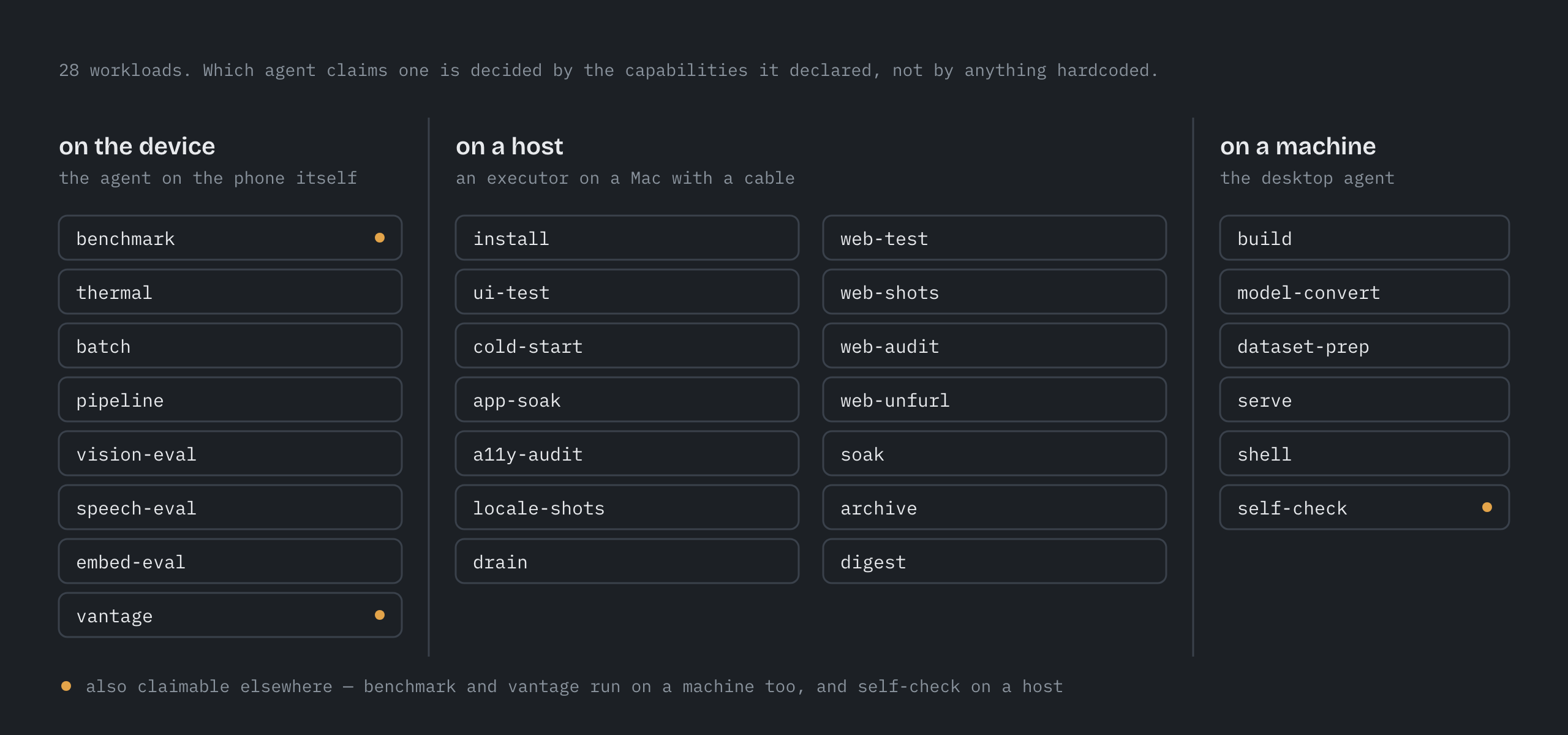
| Workload | Runs on | What it measures |
|---|---|---|
benchmark |
device, machine | Prefill and decode tok/s via llama.cpp, or a synthetic backend identical on every platform |
thermal |
device | The same benchmark back to back for a quarter hour — does the cold number survive |
batch |
device | Real generation over a set of inputs |
pipeline |
device | Staged work across several devices, with the collector as the broker |
vision-eval |
device | Top-1/top-5 accuracy and per-image latency for an image classifier |
speech-eval |
device | Word error rate and real-time factor for on-device transcription |
embed-eval |
device | Recall-at-k and throughput for on-device embeddings |
vantage |
device, machine | DNS, connect, TLS and TTFB to your own sites, from where each agent actually sits |
enrol |
host | Point every attached device's runner at a collector, without anybody typing |
install |
host | One artifact onto every attached device |
ui-test |
host | Maestro flows or an XCUITest bundle per device |
cold-start |
host | Launch from cold, warm and hot; p50 and p95 per state |
app-soak |
host | Memory, jank and crashes over hours |
a11y-audit |
host | The accessibility tree diffed against a baseline at the largest dynamic type |
locale-shots |
host | A screenshot flow under every locale, including RTL, as a contact sheet |
web-test |
host | Playwright suites, including on real phone screens |
web-shots |
host | Visual regression captures diffed against an accepted baseline |
web-audit |
host | Crawl-and-audit with a real browser |
web-unfurl |
host | The raw HTML link-preview bots actually see, which is a different answer |
drain |
host | Battery curve under a replayed GPX track |
soak |
host | Whether a runner is still alive hours later |
archive |
host | Store reviews and Search Console data, kept past the vendor's retention |
digest |
host | The shelf summarising its own reviews using its own models |
build |
machine | Check out a ref, build it, publish the product as an artifact |
model-convert |
machine | A checkpoint into GGUF, Core ML or TFLite |
dataset-prep |
machine | An eval set, carrying its licence and source on the row |
serve |
machine | Host a model for the length of a lease and announce its endpoint |
shell |
machine | A pinned script, behind an allowlist the owner controls |
self-check |
host, machine | The fleet inspecting its own hosts: disk, tool versions, clock drift |
How to read these pages
Each workload says what it measures, the shape of the job spec, the metrics it reports, and — usually the useful part — what it refuses to do. Those refusals are deliberate. A workload that quietly approximates something it cannot measure produces a number indistinguishable from a real one, and this project has been bitten by exactly that.
The three families
Device workloads run inside the agent app, on the phone or laptop itself. They are the ones that produce hardware numbers.
Host workloads run in an executor process on a Mac and drive a
device from outside, over adb or simctl. Installing a build or tapping through
a UI test is not something an app can do to itself.
Machine workloads run on a laptop or desktop agent and are about producing things the rest of the fleet consumes — builds, converted models, prepared datasets — or about the fleet inspecting itself.
Adding one
You do not need a collector release. The collector accepts any workload a registered agent declares in its capabilities; see Writing a runner.