The protocol
Everything an agent has to speak. It is deliberately small: five HTTP calls, JSON in and JSON out, no websockets, no SDK and no client library. The three runners in this repository share it and share no code — the Kotlin, Swift and TypeScript agents each implement it independently — which is the point. Anything that can make an HTTP request can be a fleet device.
The wire version is "schema": 1. Both shapes are defined in
collector/schemas/
and those files are the authority; this page is the narrative version.
The loop
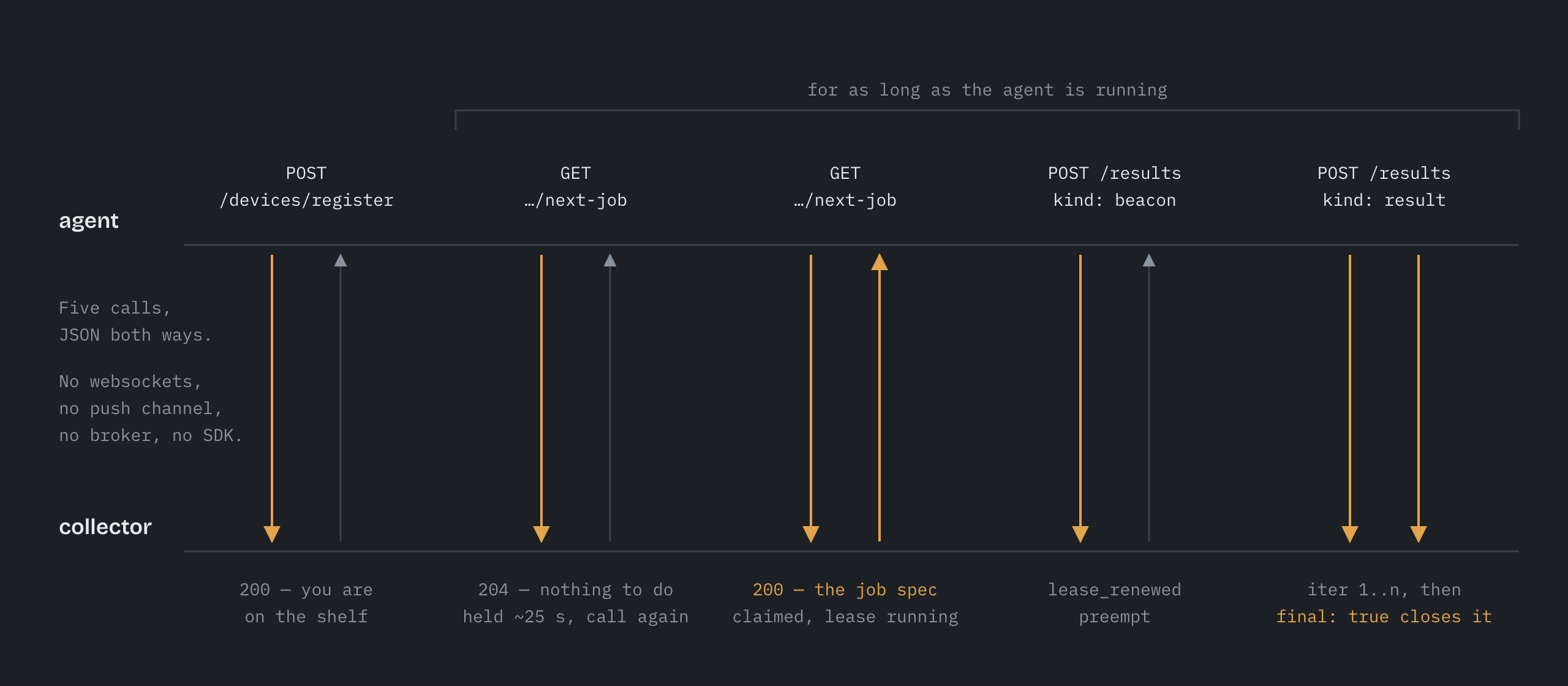
1. Register
{
  "device_id": "living-room-tv",
  "descriptor": {
    "model": "AFTKA", "soc": "Amlogic S905Y4", "ram_mb": 2048,
    "os": "android-11", "app_ver": "0.3.0", "arch": "arm64",
    "platform": "android", "kind": "tv"
  },
  "pools": ["ml-capable"],
  "capabilities": ["benchmark"],
  "ttl_s": 300
}
An upsert — call it on every startup and after every reconnect. device_id is
yours to choose and is what job specs pin; make it stable across restarts.
descriptor is what targets.match is evaluated against, so a field you
omit is a field no job can select you by. ram_mb and os are the two that
matter most in practice.
capabilities is a promise about your own dispatch. See
Capabilities for the three rules that govern it; the
one to internalise is that omitting the key means "no opinion" and sending []
means "nothing", and they are different on purpose.
platform and kind
platform is which OS family you run. An open string: android, ios,
tvos, watchos, visionos, macos, linux, windows, web are the ones
in use. Send it. An agent that omits it gets the old rule — iOS if os looks
like iOS, Android otherwise — which is kept so that a collector upgrade does
not relabel agents written before the field existed. That rule is also why the
field had to exist: it does not report a platform, it reports a guess, and
every desktop agent registered as an Android phone until it could say
otherwise.
kind is the form factor: phone, tablet, laptop, desktop, tv,
watch, headset, sbc, browser, ci, container. Null when you do not
say, never guessed — a phone and a TV stick running the same Android build are
indistinguishable from a descriptor, and inventing an answer puts a television
in a table of handsets.
Both are open sets. A platform nobody has thought of yet does not need a collector release before it can be named.
ttl_s, if you are temporary
Omit it and you are a shelf device: a phone that is switched off is still a phone and should stay in the registry reading offline until somebody picks it up. Send it and you are saying the opposite — that your absence is the end of you rather than a fault.
This is for agents whose disappearance is normal: a browser tab that was closed, a CI runner whose job finished, a container that exited. Without it, every CI run leaves a permanent offline device behind and the shelf fills with ghosts.
The window slides against last_seen, which every poll and every beacon
already refreshes, so an agent that is still working never expires out from
under its own job. When it does expire the row is kept, not deleted: the
results you posted stay attributable and GET /api/devices/:id still resolves
you. What changes is that the queue stops offering you work and you leave the
shelf.
2. Claim work
GET /devices/{device_id}/next-job     → 200 job spec, or 204
GET /executor/next-job?name={label}   → the host-job equivalent
This is a long poll, held open for about 25 seconds. A 204 means the poll
expired with nothing to do; call it again immediately. That is the whole
scheduling mechanism — there is no push channel and no broker.
A 200 returns the spec, and the job is now claimed by you with a lease
running.
{
  "schema": 1, "job_id": "bench-1", "workload": "benchmark",
  "executor": "device", "backend": "synthetic",
  "model": { "name": "qwen2.5-0.5b", "format": "gguf", "quant": "Q4_K_M",
             "sha256": "…" },
  "params": { "prompt_tokens": 256, "gen_tokens": 64, "measure_iters": 3 },
  "constraints": { "require_charging": true, "min_battery_pct": 30 },
  "lease": { "ttl_s": 600, "max_attempts": 3 }
}
Enforce constraints.require_charging and min_battery_pct yourself, before
you start, and refuse with a failed result if they are not met. Those are the
two the runner owns; the collector enforces the rest before it ever offers you
the job. See Constraints for why the split is where
it is.
3. Beacon
{
  "schema": 1, "kind": "beacon", "device_id": "pixel-4a", "job_id": "bench-1",
  "beacon": { "battery_pct": 82, "charging": true, "thermal": "nominal",
              "mem_mb": 412 }
}
A beacon does three things at once, which is why there is no separate endpoint for it:
- It renews the lease. The reply's
lease_renewed: falsemeans your claim is gone — swept, or the job already closed — and you should stop working it. That is the same signal a cancelled job produces, so handling one handles both. - It carries telemetry, which is what the battery and thermal charts are
built from. Send one every 60 s or so even when idle (omit
job_idthen). - It answers
preempt. If the reply sayspreempt: trueand your job ispreemptible, stop at a resumable point, upload your progress, and post a final row with"preempted": true. See Preemption. Ignoring the field is fine — it is additive, and not stopping is the old behaviour.
busy, if you belong to more than one fleet
An agent may register with several collectors. It is still one piece of hardware and it runs one job at a time, so the brains that are not running its job have to be told, or their queues keep offering work to a device they cannot have.
{
  "schema": 1, "kind": "beacon", "device_id": "pixel-4a",
  "beacon": { "battery_pct": 82, "charging": true,
              "busy": { "job_id": "bench-1", "collector": "http://study-mac:8788" } }
}
Send it only to the collectors that are not running the job. To the one
that is, the beacon's own job_id is already the whole story, and repeating it
as busy would be an agent describing a claim back to the brain that granted
it.
A collector that sees a fresh busy naming somebody else stops offering that
device work. A stale beacon does not block — past three minutes the claim is no
longer evidence of anything, and trusting it would mean a device that took one
job elsewhere and was then unplugged never claimed anything again.
collector is the other brain's address, and a reader is not required to be
able to resolve it. Knowing the device is unavailable is the part that matters.
Ignoring the field entirely is fine and is the old behaviour. See Belonging to more than one fleet for the rest of the contract, including the part you cannot skip.
Beacon more often than the lease TTL. A drain job with a 4-hour TTL still
beacons every minute; a benchmark with a 600 s TTL must not go 10 minutes
silent.
Handing a job straight back
Only if you registered with more than one collector, and only before you have run any of the job.
Two brains can both answer your long poll with a job in the same instant. You
can take one of them; the other is now claimed by a socket you are not
reading, and left alone it sits there until a lease sweep finds it — ten
minutes later by default, four hours for a drain, and having spent an
attempt on the way. Three such races retire a job that never misbehaved.
So say so. The job goes back to queued, the attempt is handed back, and
anything may claim it immediately.
- Refused with 409 once any result row exists for the job. That is the line between handing a job back and abandoning it half-done: if you have reported an iteration, close the job properly instead.
- Refused with 409 if
device_idis not the claimant. - A collector too old to have this endpoint answers 404. Treat that as ordinary, not as an error — the sweep is the old behaviour and it still works. An agent that failed here would be an agent that cannot talk to last month's brain.
4. Report results
The same endpoint, with kind: "result".
{
  "schema": 1, "kind": "result", "device_id": "pixel-4a", "job_id": "bench-1",
  "iter": 1,
  "metrics": { "prefill_tok_s": 125.0, "decode_tok_s": 47.4, "load_ms": 310 }
}
Rows are idempotent by (job_id, device_id, iter), so a retry after a
network failure is safe and duplicates collapse. Use iter: 1..n for
per-iteration rows and iter: 0 for the summary.
The last row for a device carries final:
{ "schema": 1, "kind": "result", "device_id": "pixel-4a", "job_id": "bench-1",
  "iter": 0, "final": true, "ok": true,
  "device": { "model": "Pixel 4a", "soc": "…", "os": "android-13" },
  "metrics": { "prefill_tok_s": 125.0, "decode_tok_s": 47.4 },
  "artifacts": ["<sha256>"] }
final: true closes the job and promotes anything waiting on it. ok is
the verdict. error carries the reason on a failure, and it is what the
dashboard shows against the job — so make it a sentence a person can act on.
Metric names are not free-form
metrics keys come from
result.schema.json.
Inventing one means it is stored but nothing queries it, which is a specific
mistake this project has already made: an eval's accuracy once rode in a field
named decode_tok_s because vision had no field of its own, and no query can
reproduce that report's numbers today.
If you need a quantity that has no name, add it to the schema in the same change
that emits it. If it is structured rather than scalar, put it in a named
top-level field instead of metrics — the collector stores a result's whole
payload, so it survives and can be rendered later, whereas folding it into
metrics means inventing metric names outside the schema.
Say how you measured, when it is ambiguous. mem_method exists because RSS on
macOS and PSS on Android are not the same quantity, and reporting one under the
other's name would be laundering.
backend and model.format are open too
Both were closed enums and are now open strings, for the same reason workload
is: the thing that makes a runtime real is a runner that can load it, and
closing the set meant a new runtime could not be named in a job until the
collector shipped a release.
Enforcement moved to capabilities, where it already was for workloads. An agent
declaring benchmark:onnx is what makes that pairing runnable; a backend no
registered agent declares is refused at enqueue with a 422 naming it.
Name your backend for what it actually is. The browser runner declares
benchmark:jssha and benchmark:webcrypto rather than benchmark:synthetic,
because a browser's only native hash is asynchronous and its rate is not the
same quantity as a phone's — see Make your numbers
comparable.
5. Artifacts
Everything the fleet moves is content-addressed. Verify the hash after downloading a model rather than trusting the transfer — the runners do, and a corrupted GGUF otherwise fails much later and much less clearly.
Uploading with x-artifact-app, x-artifact-build and x-artifact-platform
stamps the upload as a published build, which is what makes
"sha256": "latest" resolvable. There is no separate publish call.
Writing your own agent
The contract above is the whole thing. Writing a runner walks through the design decisions — capability routing, the synthetic backend that makes numbers comparable, and what to refuse rather than approximate — using the desktop agent as the worked example, because it is the smallest and it is plain TypeScript.
What the collector will not do
Worth stating, because each of these is a design decision rather than a gap:
- It never pushes. No websockets to the devices, no FCM, no APNs. Agents poll, which is what lets a phone behind NAT on a guest network participate with no configuration.
- It never kills a running job. Cancelling sets the row to
cancelled, which makes the next beacon returnlease_renewed: false. Work in flight finishes; nothing new starts. - It carries no secrets in job specs. A job names a credential; the agent
reads it from its own environment or Keychain. This is enforced by the design
rather than by validation —
POST /jobsis unauthenticated, so a spec is not a place a secret could safely live.