Alerts
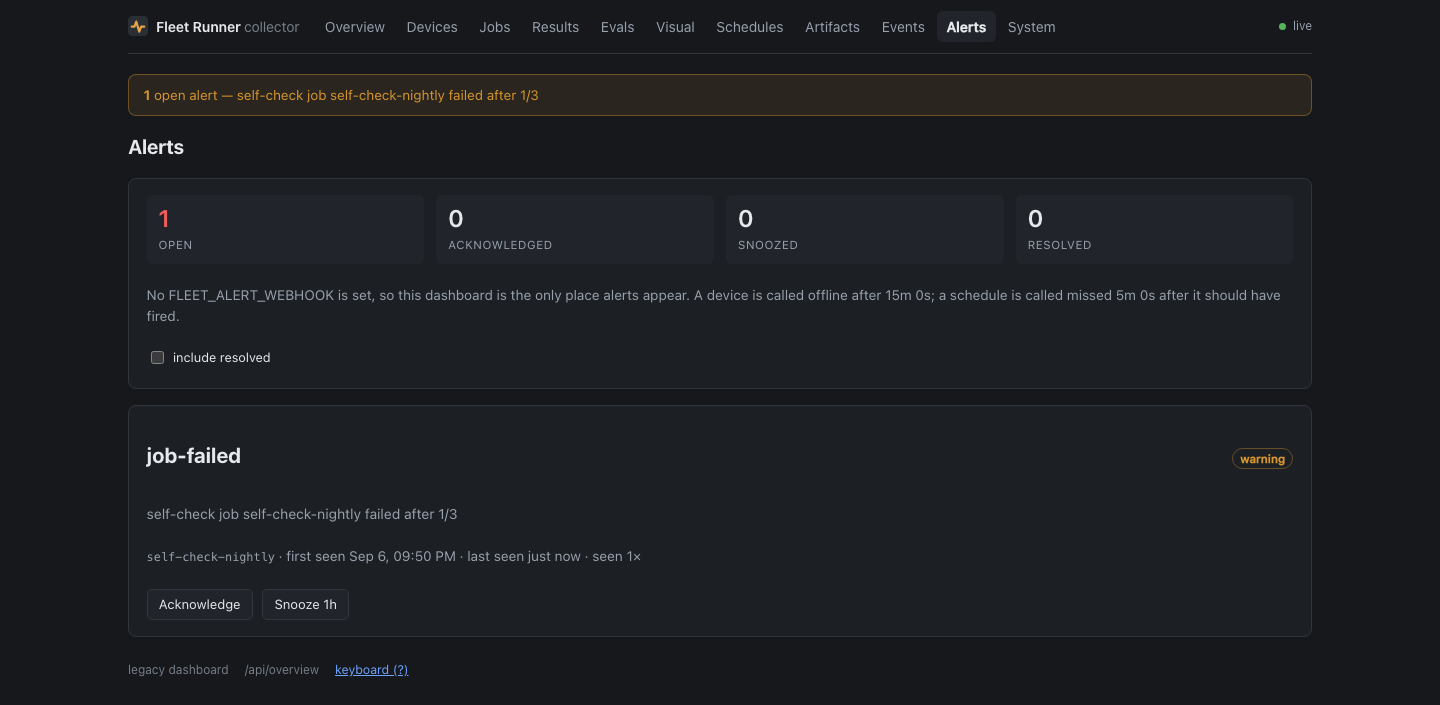
Evaluated every 60 seconds. Alerts are state, not events: one row per (rule,
subject) for as long as the condition holds, resolved when it stops. A device
offline for six hours is one row with a rising seen_count, not 360
notifications — and nothing is notified twice, ever.
The rules
| Rule | Fires when |
|---|---|
device-offline |
No check-in for FLEET_ALERT_DEVICE_OFFLINE_S (default 15 min) |
thermal-critical |
A device still reporting is thermally critical |
low-battery |
Below FLEET_ALERT_LOW_BATTERY_PCT (default 15) and not charging |
job-failed |
A job failed in the last 24 h |
job-stuck |
Claimed, lease still being renewed, but no result rows after 2× the lease TTL |
benchmark-regressed |
Decode throughput fell more than FLEET_ALERT_REGRESSION_PCT (10%) against its own 7-day median |
cold-start-regressed |
Launch time rose past the same threshold against its own median |
batch-regressed |
Top-1 accuracy fell past the same threshold |
schedule-missed |
An enabled schedule that has run before missed its firing by 5 min |
db-size / log-size |
Past FLEET_ALERT_DB_BYTES / FLEET_ALERT_LOG_BYTES |
job-stuck is the case the lease sweep cannot see: beacons keep renewing the
claim, so the job never lapses, and without this rule a runner that is alive but
producing nothing looks identical to one that is working.
Battery and thermal are only judged on devices still checking in — a reading
from a silent device describes whenever it went silent, not now. And a device
reporting -1 has no battery telemetry rather than a flat battery.
The regression rules compare against history, not a threshold
The comparison key matters more than the threshold. Two runs are only comparable on the same device with the same model, quant and backend, and comparing across any of those is how a "regression" turns out to be a different model.
The baseline is the median of the trailing seven days, needs at least four prior
runs, and the alert's subject is keyed on the same tuple the comparison was — so
a device that has genuinely got slower is one alert with a rising seen_count,
not a new one every night.
Percent rather than absolute, because the shelf spans a 2016 phone and current silicon, and one threshold in tok/s would be noise on one and silence on the other.
Getting told
FLEET_ALERT_WEBHOOK pushes newly opened alerts to ntfy or any webhook
receiver. Unset — the default — makes the dashboard the only channel.
A red nightly that reaches nobody is worse than no nightly. For a desktop
notification instead of a hosted service,
scripts/alert-receiver.ts
is a local webhook target that raises a macOS notification, installed with its
own LaunchAgent.
It runs on the machine somebody is actually looking at, not on the headless
host. Point FLEET_ALERT_WEBHOOK at the collector's own loopback port and let
the tunnel's reverse forward deliver it — loopback at both ends,
so the alert never crosses the LAN and never leaves the house.
Quieting one
Acknowledge keeps an alert listed but stops it nagging. Snooze quiets it for N minutes and it returns on its own. Only the condition clearing resolves an alert.