Architecture
Overview
The fleet is a collection of shell scripts, a Node daemon, and the GitHub runner binary — one runner process per repo, each living in its own directory. There is no container orchestration, no Kubernetes, and no cloud control plane. The unit of deployment is a macOS user account.
~/actions-runners/                  ← fleet root
├── fleet.env                       ← host-local overrides (optional)
├── project-ios/                    ← one runner directory per repo
│   ├── .runner                     ← runner config and credentials
│   ├── .env                        ← PATH and hook env vars
│   ├── _work/                      ← job checkouts and build output
│   └── _diag/                      ← runner diagnostic logs
├── project-web/
├── project-backend/
│   ...
└── dashboard/
    ├── fleetd.js                   ← the daemon
    ├── fleet.db                    ← SQLite: runs, jobs, runner state
    └── public/                     ← browser UI (plain HTML+JS, no build step)
Component diagram
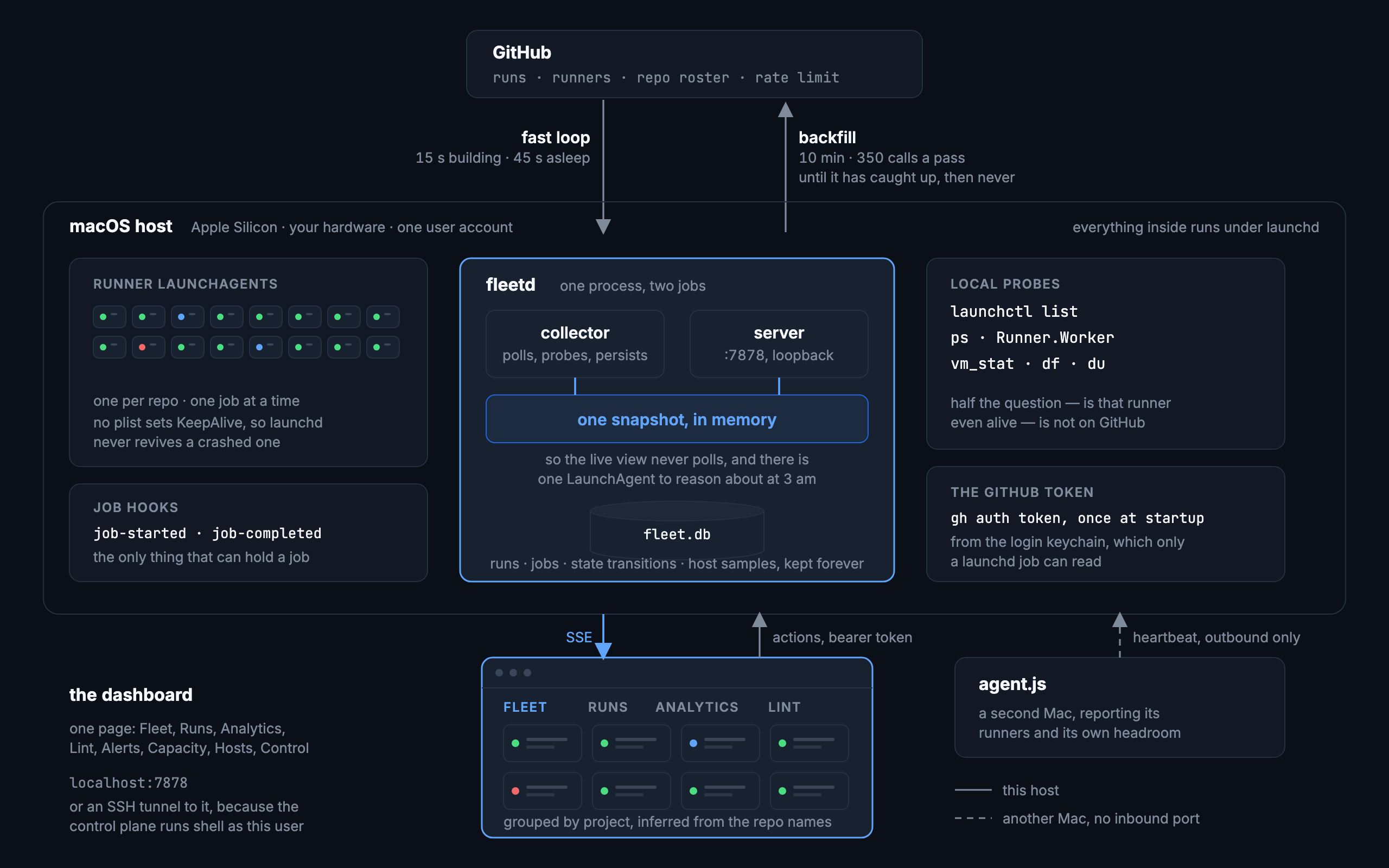
The collector polls GitHub and probes the machine. The server answers the browser. They are one process because they share the snapshot in memory: the live view never polls for it, and there is one LaunchAgent to reason about at 3 am rather than two.
Everything inside the host boundary runs under launchd, which is not a
deployment preference. gh keeps its token in the login keychain, and a
non-login session cannot read it — gh auth status reports an invalid token
over SSH while working fine in the GUI session. LaunchAgents do get keychain
access, so running under launchd is the auth mechanism, and
./fleetctl.sh run over SSH will fail to get a token unless you pass
GH_TOKEN=… yourself.
The loops
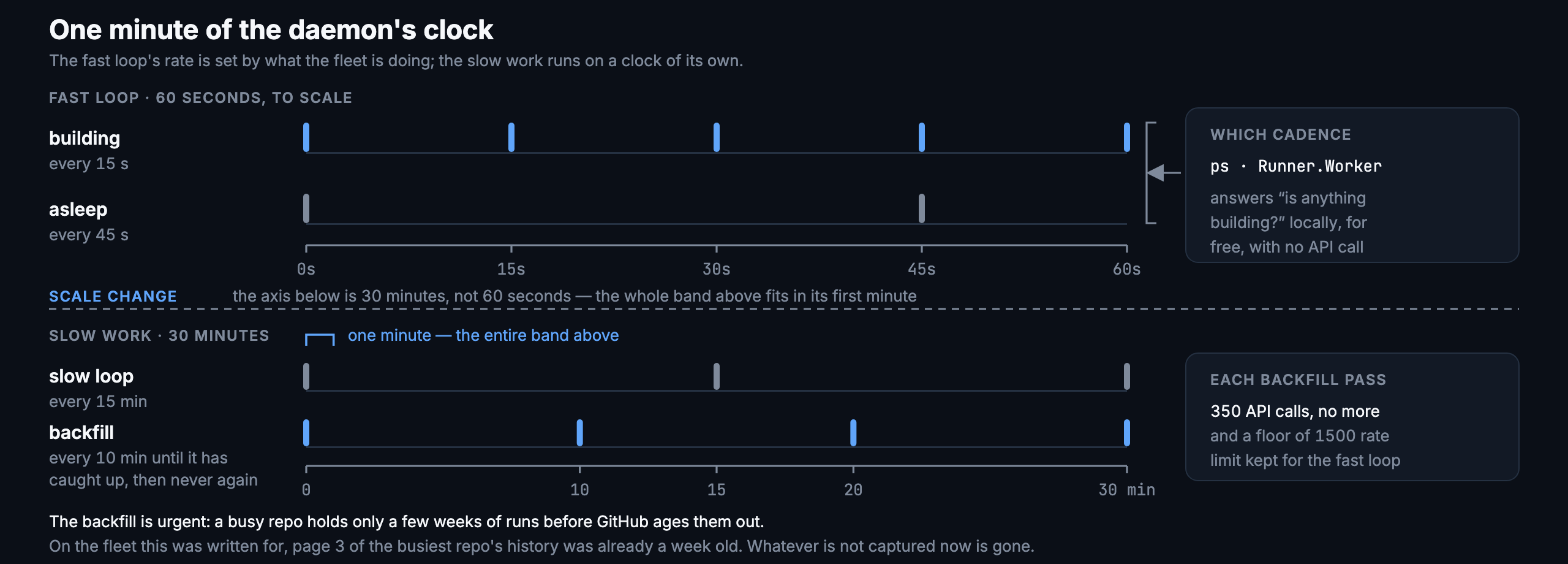
Whether to poll fast is decided from the local Runner.Worker check, which
answers "is anything building" for free and with no API call. The backfill walks
back through every run GitHub still holds; it is throttled to a bounded number
of calls per pass and keeps a rate-limit floor for the fast loop, because run
and job detail is the record GitHub deletes and nobody can recover. Every
interval here is configurable — see
Dashboard daemon variables.
Data flow and trust boundaries
There are three boundaries on the diagram above, and they are not equally trusted:
| Boundary | What crosses it | What is assumed |
|---|---|---|
| GitHub to this host | Job dispatch over HTTPS, and the daemon's polling | GitHub is trusted to dispatch only jobs from repos you registered a runner for. A fork's pull request against a public repo is a job you did not write — see Security |
| The host to the browser | The SSE snapshot out, actions in | Read access and the right to restart runners are different things. Reads are open on loopback; every action needs the bearer token, which is stored in the browser and never served to the page |
| Another Mac to this host | An outbound heartbeat from agent.js |
The agent opens the connection. No inbound port is opened on it, and the host — not the coordinator — decides what it will run. Deregistration is deliberately not in that set |
Inside the host boundary there is no isolation between runners: they run as one
user, in one account, with one PATH. A job that can write to _work on one
runner can read _work on another. That is the deployment model, and it is why
this is built for private repos with trusted contributors.
Runner processes
Each runner directory contains the GitHub Actions runner binary. The runner
is managed by a macOS LaunchAgent (~/Library/LaunchAgents/actions.runner.*.plist),
which:
- Launches runsvc.sh, which launches RunnerService.js
- RunnerService.js supervises the listener (Runner.Listener) and restarts it
on crash
- The listener waits for jobs and forks a worker (Runner.Worker) to run them
LaunchAgents are loaded at login and survive process crashes, but not
RunnerService.js crashes — that is what health.sh --repair fixes.
Dashboard daemon (fleetd)
fleetd.js is a single Node process that does two things:
1. Collects state on a timer and stores it in SQLite
2. Serves an HTTP API and the browser UI
Fast loop (15 s busy / 45 s idle): GitHub API for runs and runners, plus local probes (launchctl, ps, vm_stat, df).
Slow loop (15 min): repo roster, directory sizes, forecast evaluation.
Backfill (every 10 min until caught up): historical runs and job timings.
The fast and slow loops share one in-memory snapshot. The server reads from this snapshot; there is no per-request database read for the live view.
Hooks
The job hooks (ACTIONS_RUNNER_HOOK_JOB_STARTED and
ACTIONS_RUNNER_HOOK_JOB_COMPLETED) run inside the runner process:
- job-started: checks the admission gate (if
enforcemode), then exits 0 to allow the job to proceed. A non-zero exit would cancel the job. - job-completed: checks for a
.drain-stopfile left bydrain-runner.sh; if found, stops the service once the worker has exited.
Neither hook is installed by default. scripts/install-hooks.sh --apply wires
them up.
SQLite database
fleet.db stores:
- runs and jobs: append-only; kept forever (GitHub discards run detail
after 90 days — this is the only long-term record)
- runner_state: one row per runner, updated each fast loop
- host_samples: 1-minute host vitals (load, memory, swap, disk)
- queue_events: queue-cause transitions per queued run
- forecast_evals, autoscale_decisions, admission_log: decision records
- hosts, host_heartbeats, host_commands: federation
Schema is managed by forward-only migrations in lib/db.js. There is no
downgrade path — back up fleet.db before upgrading.
Autofix and admission
autofix/ runs inside each job's started hook, keyed on the admission module.
autofix/escalate/ is an optional third-party subtree that must be opted into
separately (see Security Hardening).
What the control token is worth
The dashboard's control plane executes shell commands as the current macOS user, which is the same user running the runners. That is intentional — the actions are the existing scripts, which keeps them the single source of truth rather than forking their logic into a web app.
The consequence is worth stating plainly: the control token grants the same
access as an SSH session to that user. Protect it accordingly. It is stored
in the browser, is never served to the page, and FLEET_READ_ONLY=1 removes
the control plane entirely. What bounds it beyond that is that every action is
execFile with an argv array against an entity the daemon already discovered —
see The control plane.
Agents (federation)
When a second Mac joins the fleet, agent.js runs on it and reports outbound
to the coordinator dashboard. No inbound port is needed on the agent host. The
coordinator never initiates a connection to agents; commands flow back via the
polling response to the agent's heartbeat.
See Federation for the operational details.