Actions Runners
Many self-hosted GitHub Actions runners on one Mac, and the page that says whether any of them is broken.
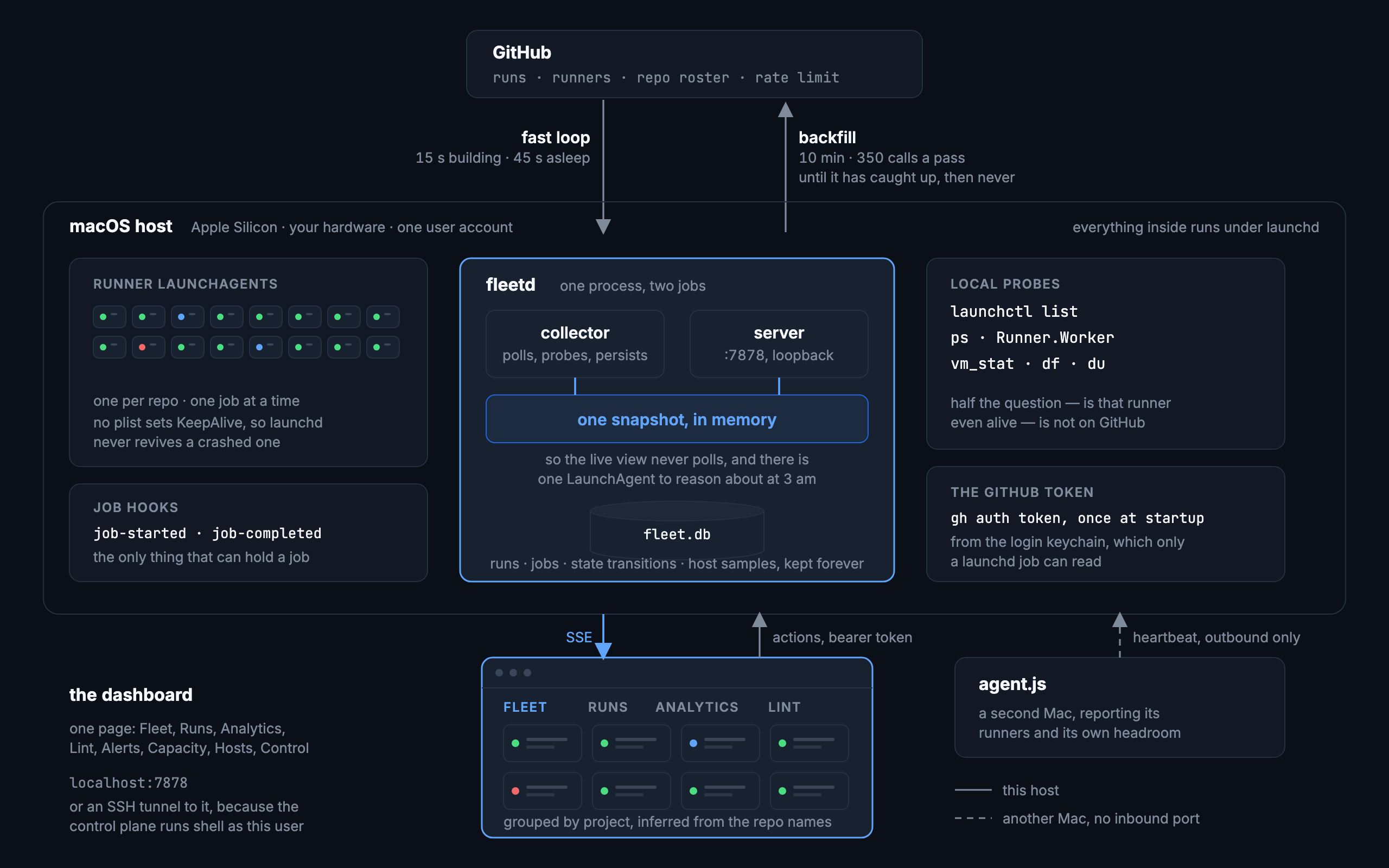
One runner per repo, each its own directory and its own LaunchAgent. One Node daemon with no dependencies and no build step polls GitHub and the machine, keeps everything it learns in SQLite forever, and serves a single page: Fleet, Runs, Analytics, Lint, Alerts, Capacity, Hosts and Control.
Start here
-
A runner registered, the dashboard up, and a real workflow job running on your own Mac. Half an hour, and one machine.
-
What a runner actually is here, what launchd will not do for it, what drift means, and why a job is queued.
-
Every tab, what each one is for, and the actions the control plane will and will not perform.
-
Health checks, draining a runner for maintenance, disk cleanup, and the incident checklist.
-
Why it is shaped this way. Each argument is grounded in something that actually went wrong on a real fleet.
-
Deployment models, the token, the runner threat model, and what binding to the LAN costs you.
Why self-host on Apple Silicon
GitHub-hosted macOS minutes bill at 10x against the included allowance on private repos. More critically, one iOS repo exhausting that allowance blocks Actions account-wide, which takes down the cheap Ubuntu jobs in unrelated repos with it. A fleet on hardware you own removes that shared fate.
The cost you pay is owning the host's health. Idle listeners are nearly free at about 7 MB each; two simultaneous Xcode builds are not. The dashboard and admission control exist to make that visible and manageable.
The half of the question GitHub cannot answer
GitHub has no cross-repo Actions view. Past a handful of repos there is no single page that answers is anything running — and once runners live on a particular machine, is that runner even alive is not answerable from GitHub at all.
So the interesting state is the state where the two disagree.
Drift is the six
ways launchd and GitHub can silently stop agreeing about a runner, and each one
is invisible from whichever side you happen to be looking at. A runner
registered on GitHub with no LaunchAgent queues jobs forever. A listener GitHub
calls offline looks fine locally. No runner plist sets KeepAlive, so a
crashed service is never revived, and the only symptom is one repo's jobs
queuing while every other repo looks healthy.
A warning worth reading before you deploy anything
Self-hosted runners and public repositories do not mix
Any fork's pull request can execute code on your Mac. This project is built for private repos with trusted contributors. Read the security guide before you register anything.
The dashboard binds to loopback by default, because its control plane executes
shell commands as the user running it. Putting it on the LAN opens the read
routes to the network; every action still needs the bearer token, and
FLEET_READ_ONLY=1 removes the actions entirely.
What runs where
macOS 14 or later on Apple Silicon. One Mac, no Kubernetes, no cloud
control plane. The runner binary is osx-arm64 only and the scripts assume
Homebrew at /opt/homebrew; there is no Intel support and no plan to add it.
If you want cloud autoscaling, use
actions-runner-controller
instead.
A second Mac joins by running agent.js, which reports
outbound on a heartbeat. No inbound port is opened on it, and it computes its
own headroom, because it is the only machine that knows its own load.